THE SHORT ANSWER
Your starting point
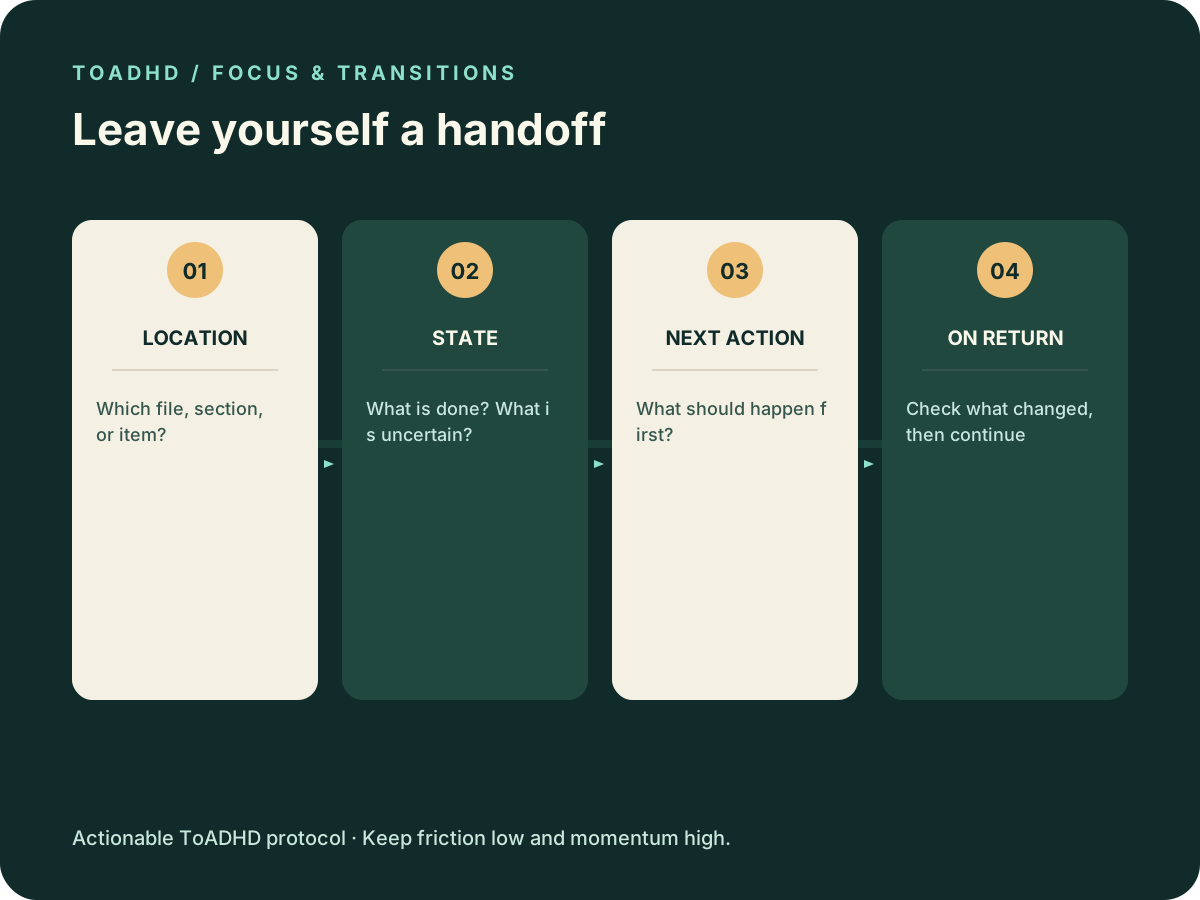
Before switching, save your work and note the exact location, current state, and next action. When you return, read that note and check whether anything changed while you were away. Resume one concrete action instead of reopening every tab and reconstructing the whole project.
IN 30 SECONDS
What to remember
- A useful handoff note names the file and the exact unfinished point.
- Saving a file and recording your place are separate actions.
- Check for changed inputs before following an old note.
- A return note is practical support, not proof that interruptions become harmless.
Leave instructions for your returning self
A note that says “finish spreadsheet” leaves almost everything unspecified. A note that says “Budget workbook, travel tab, row 18: confirm the duplicate before updating the total” preserves a usable location and decision.
If an interruption is urgent, deal with it first. For ordinary interruptions where you can spare a brief pause, save the file and leave a handoff. This guide expands that handoff into a concrete return procedure rather than repeating a general task-starting technique.
What the interruption research does and does not show
A University of Washington report on research by Sophie Leroy and Theresa Glomb describes benefits of a brief ready-to-resume plan for attention and performance on an interrupting task. The reported studies did not test improved performance on the original task after returning.
That distinction matters: the return checklist below is our editorial application, not a proven ADHD-specific intervention. Use it because it preserves useful work information, and evaluate whether it helps your own workflow.
Sources: [1]
Capture location, state, and next action
Write the note where you will encounter it when reopening the work. A document comment, top-of-file note, or task description can work if it is appropriate for your workflow. Do not scatter the pieces across several apps.
Location — Name the file, section, tab, or physical item.
State — What is complete, and what remains uncertain?
Next action — What should happen first when you return?
Return cue — When or after what event will you revisit it?
Two handoffs that preserve different kinds of work
For a document, an illustrative note might read: “Project brief, options section. The first option is described. Next: add the second option using the approved notes, then compare costs. Return after the check-in.” This separates unfinished writing from later comparison.
For a spreadsheet: “Budget workbook, travel tab. Rows 1–17 checked. Row 18 may duplicate row 12; do not change the total until checked. Return after lunch.” Here the note preserves a caution as well as a location. Follow your team's rules for editing shared files.
On return, verify before continuing
Open the named location and read the note. Check whether a collaborator changed the file, a decision arrived, or the priority moved. If the note is still valid, perform its next action. If not, replace the next action with one that fits the current state.
Do not force a stale plan because you wrote it earlier. The note is a record of where you were, not a commitment to ignore new information. If the task is no longer needed, close it through your normal process.
If the interruption happened before you left a note
Start with the most reliable evidence: the last saved section, the task's comments, or the current physical arrangement. Reconstruct only enough to identify the next safe action. For shared work, ask a specific status question if you cannot tell what changed.
Then write the handoff you wish you had found. If interruptions are frequent, keep a small running state note during work so the next interruption does not depend on having a free minute.
COMMON QUESTIONS
A few honest answers
Is this the same as keeping a to-do list?
A to-do list identifies work to do. A handoff note preserves the state inside a particular task: where you stopped, what remains uncertain, and what to do next.
Should I ignore interruptions until I write a note?
No. Respond appropriately to urgent needs and your responsibilities. Use a brief handoff when the situation allows it, or reconstruct your place afterward.
SOURCES & REVIEW
Sources and further reading
- 1Task interrupted: A plan for returning helps you move on ↗
University of Washington
This guide offers general productivity education. It cannot diagnose ADHD or replace care from a qualified professional.