THE SHORT ANSWER
Your starting point
When a task feels impossible to start, stop trying to finish it in your head. Define a tiny visible finish line, name one physical action, remove one decision, work for five minutes, and leave a clear restart note. The goal is not instant motivation. It is to make the next move obvious enough to begin.
IN 30 SECONDS
What to remember
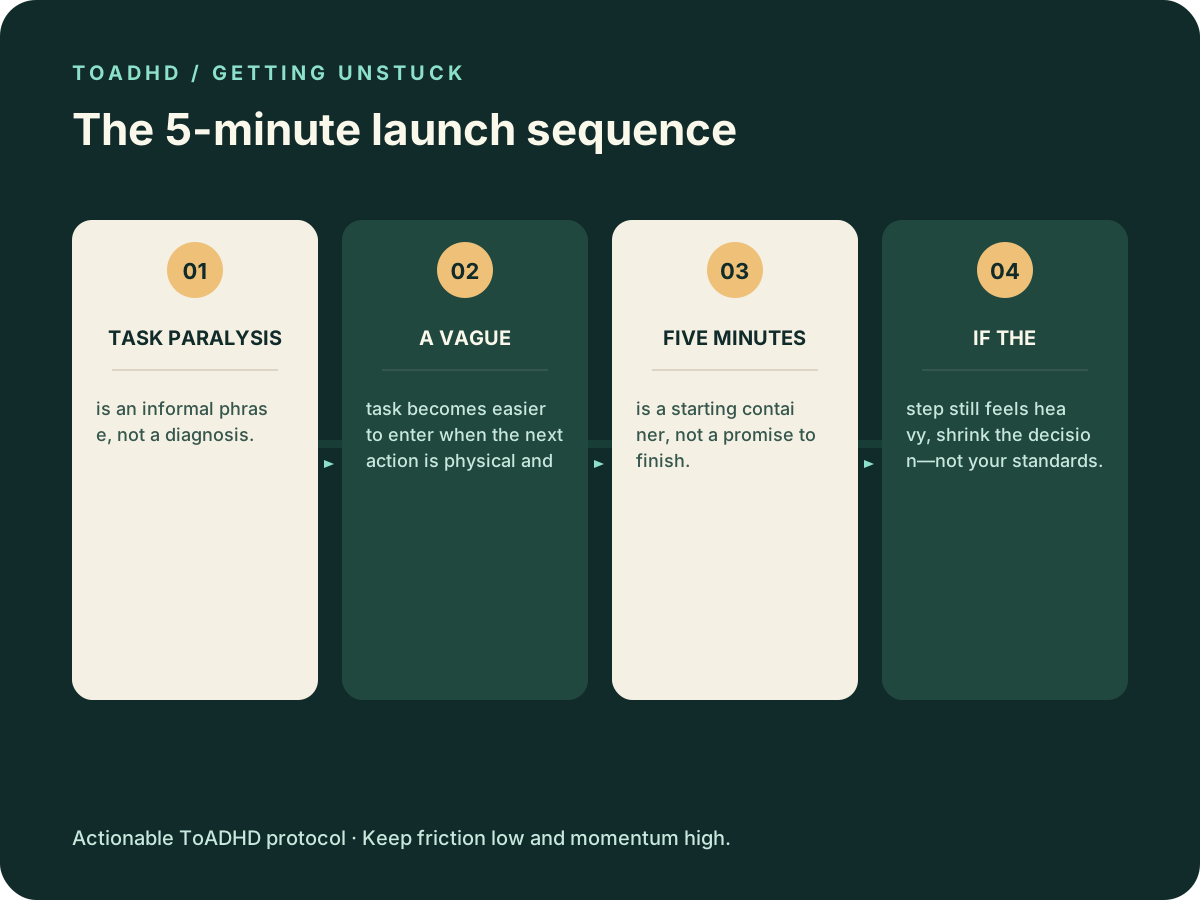
- “Task paralysis” is an informal phrase, not a diagnosis.
- A vague task becomes easier to enter when the next action is physical and visible.
- Five minutes is a starting container, not a promise to finish.
- If the step still feels heavy, shrink the decision—not your standards.
What people mean by ADHD task paralysis
“ADHD task paralysis” is a popular, informal way to describe the experience of knowing what you want or need to do while feeling unable to start. It is not a clinical diagnosis. People use the phrase because the gap between intention and action can feel real: the task matters, the deadline may be close, and still the first move does not happen.
ADHD can involve difficulty staying on task, organizing, managing time, planning, and finishing large projects. The National Institute of Mental Health lists these among challenges some adults with ADHD experience. That does not mean every stuck moment is caused by ADHD, or that one technique works for everyone. It does explain why “just try harder” is rarely a useful instruction.
Sources: [1]
Why starting can feel harder than doing
Many task labels are actually compressed projects. “Organize the home office” hides finding documents, choosing where to begin, interpreting forms, checking numbers, and tolerating uncertainty. “Clean the apartment” contains dozens of possible starting points. Before your hands can move, your brain is being asked to choose, sequence, estimate, and remember.
The emotional layer can add more friction. If the task has been delayed, opening it may also mean meeting guilt, uncertainty, or fear of doing it badly. Waiting to feel fully ready gives those feelings control of the start. A better target is a move that is small enough to do while readiness is still absent.
The five-minute task launch
Use this sequence when you are circling a task, switching tabs, or repeatedly telling yourself you will begin in a minute. You can write the answers in a note or say them out loud. Keep each answer short.
- 1
Name a tiny finish line. Replace “work on it” with a result you can see: “a rough opening paragraph exists” or “all cups are beside the sink.”
- 2
Choose one physical action. Start with a verb and an object: open the invoice folder, place the laundry basket by the door, or type three possible headings.
- 3
Remove one decision. Pick the first reasonable file, section, tool, or location. You can improve the choice after the task is moving.
- 4
Set a five-minute container. Work until the timer ends. Five minutes is permission to enter the task without agreeing to finish it today.
- 5
Leave a restart breadcrumb. Before you stop, write the exact next action: “Next: compare the total with the bank statement.”
Three examples: from frozen to moving
The size of the project does not determine the size of the first action. A useful first action changes the state of the work and makes the second action easier to see.
Overdue email — Hidden project: decide what to say, explain the delay, answer every point. Five-minute launch: open the thread and write one sentence that answers the sender’s main question.
Messy room — Hidden project: decide where everything belongs and clean every surface. Five-minute launch: put all visible trash into one bag; leave sorting for a separate step.
Work report — Hidden project: research, organize, write, edit, and format. Five-minute launch: create the document and write five rough section headings.
If the first step still does not work
A step can look small and still contain a hidden decision. “Open the document” may require finding which document. “Start researching” has no boundary. “Tidy the desk” asks you to decide where every object belongs. Treat the resistance as information about the instruction.
Use the check below instead of repeating the same command more loudly.
Too vague? Add one object and one location: “Open the project deliverables spreadsheet from Favorites.”
Too many choices? Use a default: “Start with the shortest email.”
Too emotionally loaded? Separate opening from responding: “Read the message once and copy the main question into a note.”
Too large? Make the output smaller: one heading, one dish, one number, one paragraph.
Too lonely or slippery? Work quietly beside someone or send a neutral start message: “I’m opening the file now.”
What usually adds more friction
Some productivity advice accidentally turns starting into a larger project. Building a perfect system, rewriting the entire list, or searching for the ideal method can feel productive while keeping the original task untouched.
Avoid making the timer a threat. If “five minutes” becomes a test you can fail, remove it and choose one tiny output instead. Avoid moral language too: a delayed task is a problem to redesign, not evidence about your character.
Do not plan every step before taking the first one.
Do not make “get motivated” a prerequisite.
Do not turn a rough first pass into a final-quality test.
Do not punish a restart by calculating all the time already lost.
When practical tips are not enough
Starting strategies can reduce friction, but they are not a diagnosis or treatment. If attention, organization, or task completion is repeatedly disrupting work, study, relationships, or daily life, consider speaking with a qualified healthcare professional. ADHD assessment looks at persistent patterns, history, multiple areas of life, and other possible explanations—not one difficult afternoon.
Treatment and support can include medication, psychotherapy, behavioral approaches, coaching, accommodations, or a combination suited to the individual. A clinician can help you evaluate options safely.
COMMON QUESTIONS
A few honest answers
Is ADHD task paralysis an official diagnosis?
No. It is an informal phrase people use for feeling unable to start or switch tasks. Only a qualified professional can assess ADHD, using a broader history and pattern of symptoms.
Why do I freeze even when the task is important?
Importance does not automatically make the next action clear. A task may hide choices, unclear boundaries, emotional discomfort, or several dependent steps. Naming one physical action reduces that interpretation work.
What if five minutes feels too long?
Use one visible output instead of time: open one envelope, write one heading, or move one item. The method works by lowering the entry cost, not by enforcing a particular duration.
Should I finish once I have started?
You can continue if it feels useful, but you do not have to. A planned stop with a clear restart note protects the next session and keeps five minutes from becoming a hidden obligation.
SOURCES & REVIEW
Sources and further reading
- 1ADHD in Adults: 4 Things to Know ↗
National Institute of Mental Health
- 2Attention-Deficit/Hyperactivity Disorder in Adults: What You Need to Know ↗
National Institute of Mental Health
This guide offers general productivity education. It cannot diagnose ADHD or replace care from a qualified professional.