THE SHORT ANSWER
Your starting point
Choose one thing you want to answer or solve by the end of the session. Select a small amount of course material, attempt a question without looking when appropriate, check the answer, and write down the specific gap. Use that gap to choose the next practice task.
IN 30 SECONDS
What to remember
- A study target describes what you will practice, not just how long you will sit.
- Use course questions or learning objectives to narrow the material.
- Check your attempt so errors do not become the final version.
- Record one specific gap rather than labeling the entire topic confusing.
Turn the subject into a question
“Study biology” does not specify what you will do at the desk. “Explain how water moves across this membrane” gives you a target you can attempt. Write one question from a lecture objective, assigned practice set, or instructor's review sheet.
The UNC Learning Center recommends active engagement with material, including self-testing, rather than relying only on rereading. The session card here is our practical adaptation of that general study guidance; it is not a claim that one routine works for every learner with ADHD.
Sources: [1]
Use a question, attempt, check, gap card
A sheet of paper is enough. Avoid spending the session building a new flashcard system unless making those cards is the actual assigned task. Select material you have a reasonable chance of engaging with today.
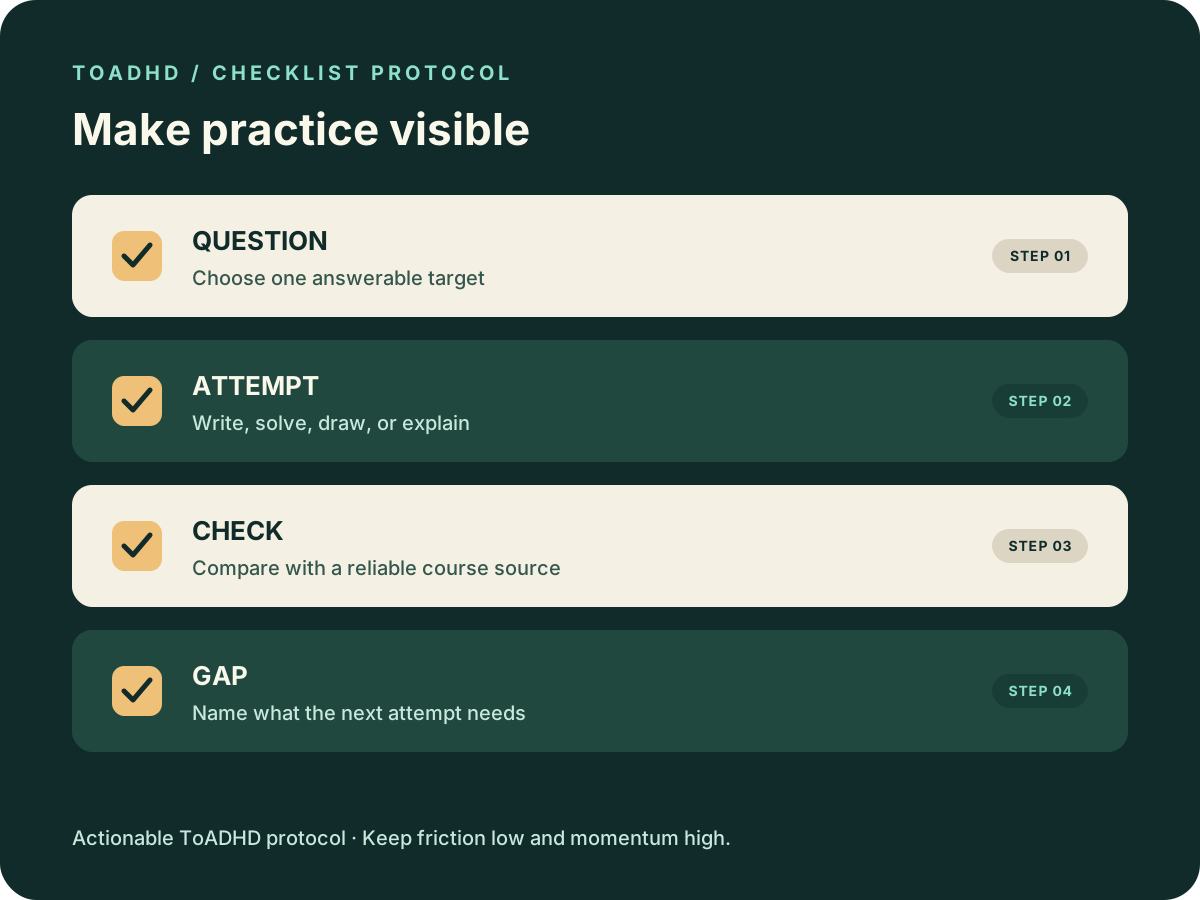
Question — What will I try to answer or solve?
Attempt — What can I write, draw, explain, or calculate?
Check — Which course source or worked solution will I compare against?
Gap — What specific missing idea or mistake should I practice next?
Example for a reading-heavy course
Imagine your target is “Explain two reasons the policy changed.” Read a bounded part of the assigned material, then close it and write your current explanation. Reopen the text and check whether each reason is actually supported. Correct your note using a page or section reference.
If you cannot recall anything, reduce the target to one reason and read for that question. The gap note could be “I can name the budget issue but cannot explain the voting change.” That gives the next session a narrower job than rereading the entire chapter.
Example for a problem-based course
For a math or coding course, choose a representative problem at the level you are currently learning. Try the next step yourself before consulting the solution, then compare your reasoning. If the material is new, study a worked example first rather than turning every session into a closed-book test.
Record the kind of error: chose the wrong operation, missed a condition, lost a sign, or did not understand a concept. A note such as “check the input range before applying the formula” can guide another attempt. Simply copying the correct answer does not tell you where your own approach changed.
Give the session a practical stop condition
A stop condition might be “attempt three questions and check them” or “explain one concept and identify the unresolved part.” The numbers are examples, not validated ADHD study doses. Choose an amount that fits the time and energy you have.
When you pause, leave the checked attempt beside the gap note. At the next session, start with that gap or choose a new course priority. A timer can remind you to review your plan, but elapsed minutes alone do not show which material you practiced.
Know when the next step is asking for help
If the same gap remains after a few deliberate attempts, bring your worked example and your exact question to office hours, tutoring, or a study group. “I lose the reasoning between these two lines” gives a helper something concrete to explain.
Use approved accommodations and course support where available. A productivity workflow can organize practice, but it cannot substitute for teaching, accessible materials, or individualized support.
COMMON QUESTIONS
A few honest answers
Should every study session be closed-book?
No. New material may need explanation and worked examples first. You can alternate studying, attempting, and checking according to the task.
What if making flashcards takes all my time?
Use existing course questions or a small handwritten question set for this session. Building a resource and practicing with it are separate tasks; choose which one you intend to do.
SOURCES & REVIEW
Sources and further reading
- 1Studying 101: Study Smarter Not Harder ↗
UNC Learning Center
This guide offers general productivity education. It cannot diagnose ADHD or replace care from a qualified professional.