THE SHORT ANSWER
Your starting point
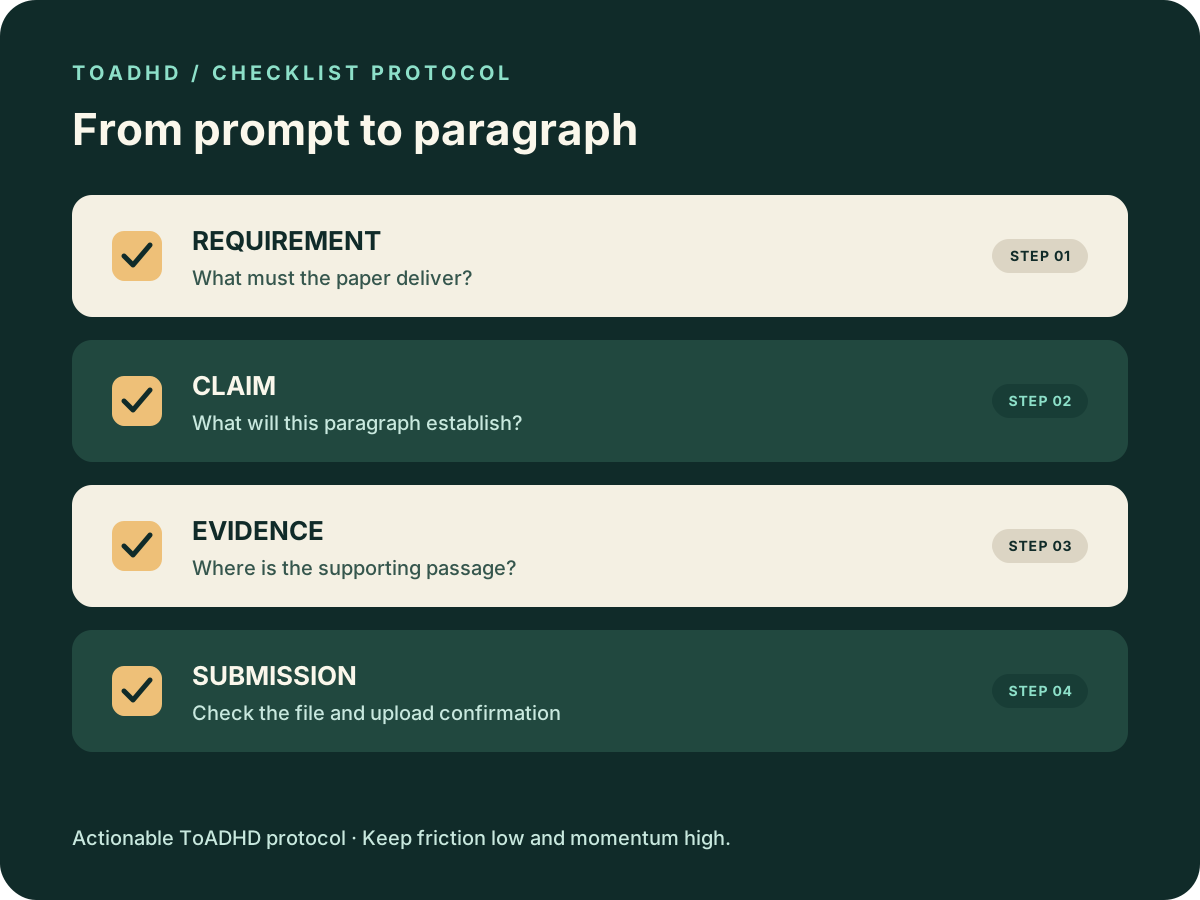
Start an essay by extracting what must be submitted, what the question asks, and what evidence is required. Give each requirement a visible place in your document. Then draft the paragraph for which you already have usable evidence. You can write the introduction later.
IN 30 SECONDS
What to remember
- Turn the prompt into checkable requirements before researching.
- Pair each planned paragraph with a claim and a source location.
- Draft the easiest supported paragraph first.
- Keep questions for your instructor separate from work you can already do.
Read the prompt as a set of requirements
If you keep opening an assignment and closing it again, the instruction may still be too compressed. “Write a critical essay” does not tell you which document to open or which paragraph to attempt. This guide offers a practical planning aid for that situation; it is not a tested treatment for ADHD.
The UNC Writing Center recommends examining the assignment's task, key verbs, and logistical details and asking for clarification where needed. Before starting new research, record the required output and the exact question in your own words.
Sources: [1]
Make a four-line assignment card
Use the original prompt as the authority. A template should help you follow the assignment, not replace its instructions. Put this card at the top of a working document and remove it before submitting.
Deliverable — What file, length, format, and submission location are required?
Question — What must the essay explain, compare, evaluate, or argue?
Evidence — Which readings, source types, or minimum references are required?
Check — What does the rubric reward, and when is the submission due?
A worked example: comparing two explanations
Imagine a class asks for a 1,200-word comparison of two explanations of urban growth using three assigned readings. This is an invented example, not a model for every subject. A useful first plan would name the two explanations and create three comparison headings: causes, supporting evidence, and limitations.
Under “causes,” write a rough claim such as “The explanations assign different roles to transport.” Add a source location from your reading notes. Do not invent a quotation or citation to fill the space. If the evidence is missing, write “find passage about transport” as a task, not as an unsupported statement in the essay.
Move from the map to actual sentences
Choose one paragraph card with evidence already available. Write the claim in ordinary language, paraphrase the relevant passage accurately, and explain how it supports your comparison. Add a provisional citation using the required style. Leave a clear marker if page details still need checking.
Only after a few body paragraphs exist, revisit your overall argument. A working thesis is allowed to change as you compare the evidence. You do not need a polished opening sentence as the entry point to the paper.
- 1
Open one assigned reading. Go directly to a relevant marked passage.
- 2
Fill one paragraph card. Keep the claim narrow enough for that evidence.
- 3
Write a rough paragraph. Prioritize meaning over elegant phrasing.
- 4
Check the prompt again. Confirm the paragraph advances the assigned task.
Handle missing information without parking the whole essay
If the prompt is genuinely ambiguous, send a specific question: “Should the comparison cover both historical periods, or only the later one?” While waiting, work on a confirmed requirement such as reading the assigned source or recording citation details.
If every paragraph needs more research, choose one question and one source to inspect. An unbounded “research essay” task can expand indefinitely. If the deadline is close, check the course policy and ask your instructor about available options instead of assuming an extension or a penalty.
Use a submission check that catches the last gap
An essay is not submitted just because the writing is finished. Leave space for checking the rubric, references, file format, and upload confirmation. Reopen the uploaded file if the system allows it and verify that it is the intended version.
Save the four-line assignment card for your next paper. Keep its headings, but replace every requirement with the new prompt's actual instructions.
COMMON QUESTIONS
A few honest answers
Should I write the introduction first?
You can, but you do not have to. If the opening keeps you stuck, draft a supported body paragraph and return to the introduction once the argument is clearer.
Can I ask AI to write the essay?
Follow your course's AI and academic-integrity rules. A task breakdown can organize the process; it does not replace reading, checking sources, or doing the assessed work yourself.
SOURCES & REVIEW
Sources and further reading
- 1Understanding Assignments ↗
UNC Writing Center
This guide offers general productivity education. It cannot diagnose ADHD or replace care from a qualified professional.