THE SHORT ANSWER
Your starting point
Write down what is actually due, what happens if it waits, and whether someone else is blocked. Remove tasks you cannot act on yet. Choose a meaningful next action that fits your available time. When two commitments cannot both fit, clarify the tradeoff with the person who can decide.
IN 30 SECONDS
What to remember
- Urgency needs a date or a consequence, not just a strong feeling.
- A short task may matter because it unblocks someone else.
- Waiting for information is a different state from avoiding available work.
- Conflicting commitments may need a decision from another person.
Replace “urgent” with a concrete fact
A list where every item says “urgent” offers little help. Add one sentence to each candidate: “Due at noon because the team sends the file at one,” or “No date agreed; requester wants an estimate.” That gives you something you can compare.
OpenStax's prioritization guidance emphasizes understanding task requirements and considering importance, impact, and urgency. The decision card below is an editorial tool for applying those ideas to a crowded workday, not a validated ADHD assessment.
Sources: [1]
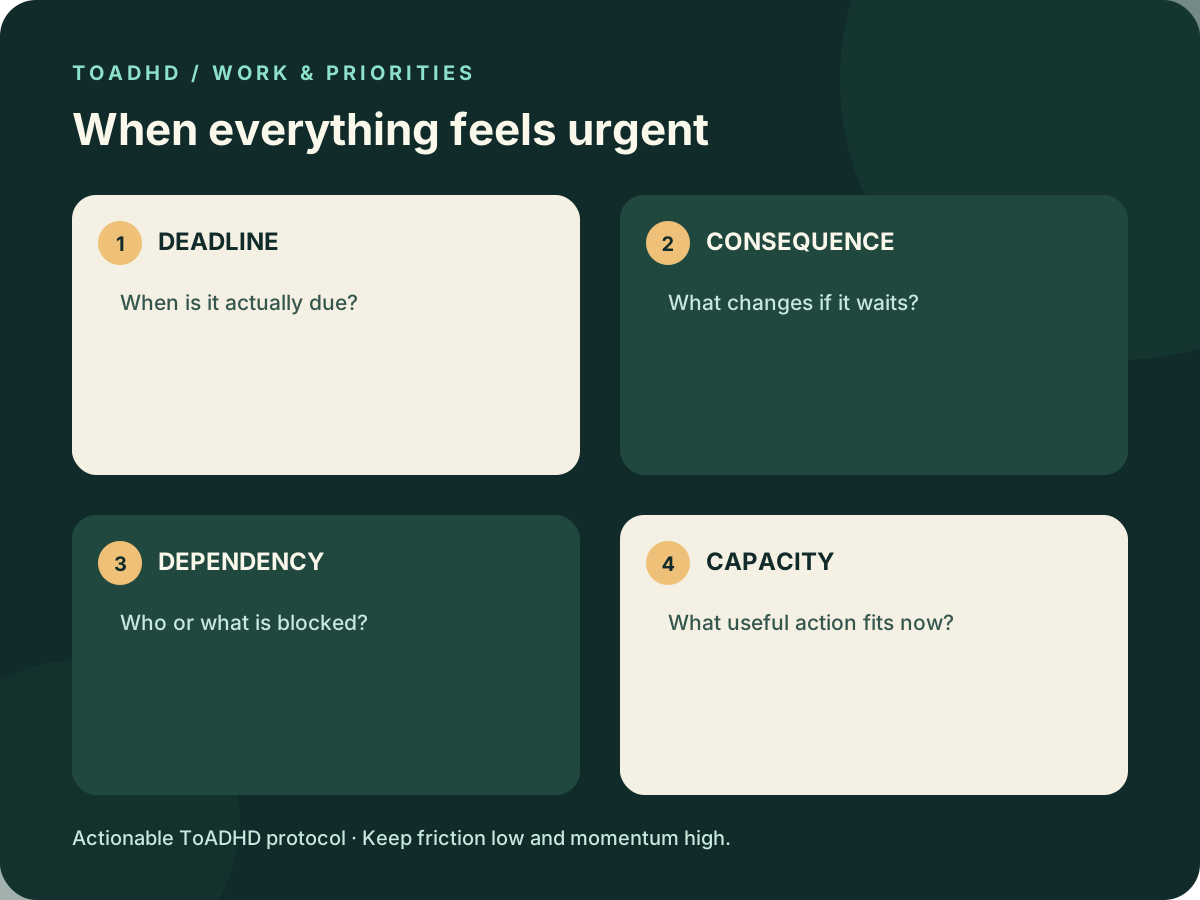
Use a four-question decision card
Compare the few tasks competing for your next work block rather than ranking your entire life. Where a fact is missing, write a question instead of assigning an invented priority score.
Deadline — What is the actual due time, and who set it?
Consequence — What changes if this waits until the next available block?
Dependency — Who or what cannot proceed until this action happens?
Capacity — What useful part can I do with the time, information, and energy available?
Example: three requests, one work block
Imagine you have 40 minutes before a meeting. A slide deck is due tomorrow, a teammate needs a document link before a noon review, and your inbox has unread newsletters. The document link is a small action with a real dependency, so you might send it first.
Then use the remaining block to draft the deck's decision slide, assuming you have its inputs. Newsletters can wait. This is an invented scenario, not a universal rule to always do the shortest task first. If the link requires an hour of permission cleanup, the comparison changes.
Do not treat a blocked task as immediately executable
If you need a manager's decision or a missing file, name the unblock action. “Ask which figures are approved” is available; “complete the approved chart” may not be. Send the request through the normal channel and record when you will check back.
Keep the waiting item visible in your usual task system, then choose another available action. Do not repeatedly reopen an empty folder and call that progress on the blocked deliverable.
Use a tradeoff message when the work does not fit
Some lists cannot be solved by personal organization. If two requests both require the same time, share the conflict before the deadline when possible. Give the decision-maker a concrete choice with realistic information.
For example: “I have capacity to complete either the deck review or the data cleanup before 3. The review is needed for today's meeting; the cleanup would let the analyst start tomorrow. Which should come first, and can we move the other deadline?” Adapt this to your workplace and do not promise capacity you have not checked.
Translate the selected priority into an output
Once you choose, write the result for the next work block. “Draft the decision slide with the two available options” is easier to verify than “work on presentation.” Keep the other candidates in your list without displaying them as simultaneous obligations.
At the end of the block, check what changed: finished, still active, or newly blocked. Reconsider priority when a fact changes, such as a deadline or dependency, rather than every time another notification arrives.
COMMON QUESTIONS
A few honest answers
Should I always do the easiest task first?
No. Ease is one factor. A small action is a strong choice when it has a meaningful consequence or unblocks work; otherwise it can displace a more important task.
What if everything really is due today?
Estimate what can actually fit and communicate the conflict. Ask about scope, order, help, or moving a deadline. A prioritization tool cannot create extra hours.
SOURCES & REVIEW
Sources and further reading
- 12.4 Prioritization ↗
OpenStax, Rice University
This guide offers general productivity education. It cannot diagnose ADHD or replace care from a qualified professional.