THE SHORT ANSWER
Your starting point
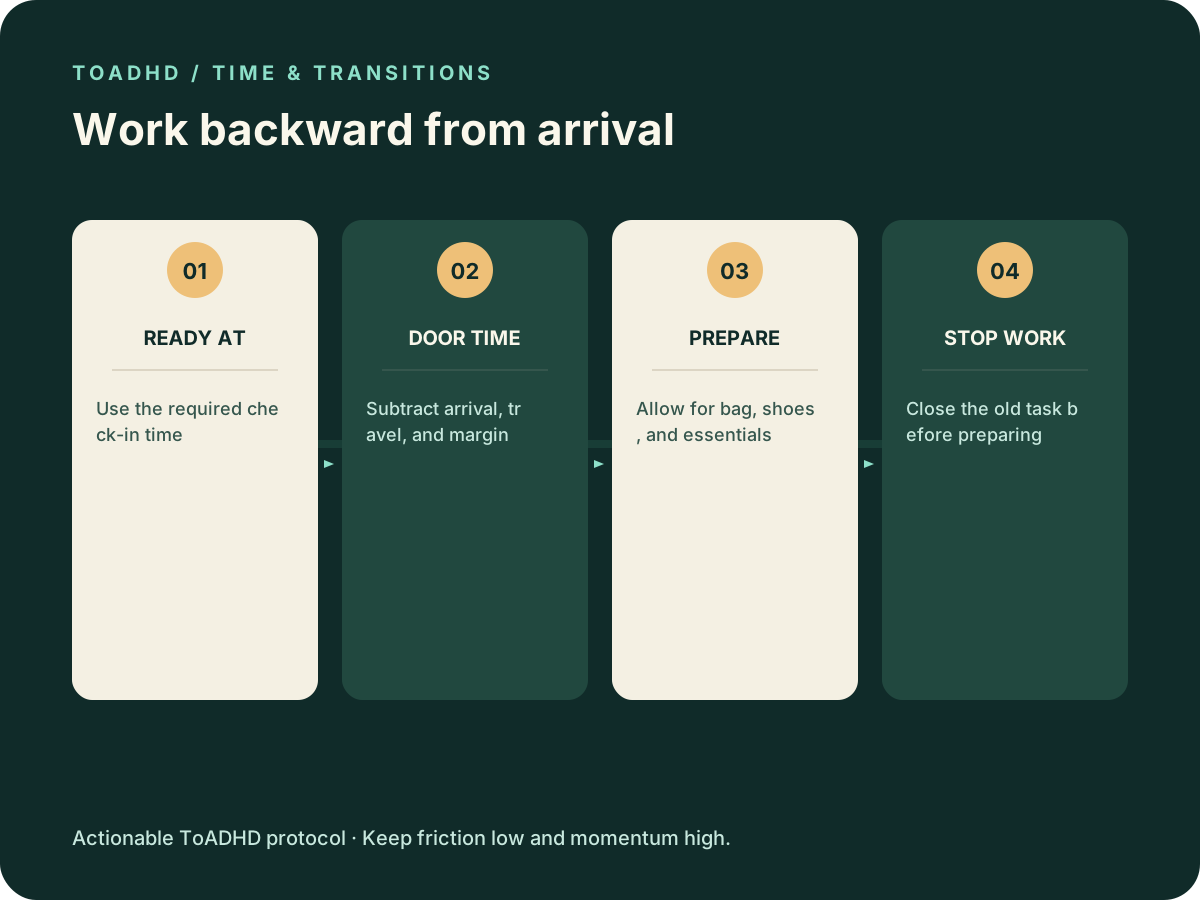
Start with the time you must be ready at your destination, then work backward through arrival logistics, travel, getting out the door, and stopping your current activity. Put the preparation cue earlier than the departure cue. Check the estimates against what actually happened and adjust the next plan.
IN 30 SECONDS
What to remember
- An appointment time is not a departure time.
- Include parking, walking, check-in, and gathering essentials.
- Use separate cues for stopping, preparing, and leaving.
- Update estimates with observed times rather than adding blame.
Build the plan backward
Use real appointment instructions and current travel information. The buffer should reflect uncertainty in your route and situation; there is no single correct number for every trip.
- 1
Write the ready-at time. Use the required check-in or seated time, not just the event's headline time.
- 2
Subtract arrival logistics and travel. Include the walk from the stop or parking place.
- 3
Subtract leaving preparation. Include shoes, bag, keys, and locking up.
- 4
Choose a stop-work cue. Leave enough room to close your current task and begin preparing.
Example: a 10:00 appointment with a 9:50 check-in
Suppose check-in is required at 9:50. You estimate ten minutes for parking and walking, 25 minutes for travel, and ten minutes of extra travel margin. That gives you a door time of 9:05.
If shoes, bag, and locking up usually take 15 minutes, preparation starts at 8:50. If closing your work takes another five minutes, the first cue belongs at 8:45. These are illustrative numbers, not route advice. Substitute your own observations and current conditions.
Make each cue say what changes now
Label a reminder with an action: “Save the document and close work,” “Shoes and bag,” or “Leave for check-in.” A cue labeled only “appointment” leaves you to reconstruct the schedule while you are already busy.
Put essentials in an agreed landing place ahead of time when practical. If an item cannot be packed early, leave a note beside the bag naming it. Choose reminders you can reliably notice; do not assume every browser notification will arrive or make a sound.
When the plan slips, remove optional tasks
If it is already 8:58 in the example, do not squeeze in another household chore. Compare the remaining essential actions with your door time. Communicate a delay when appropriate and follow the destination's instructions.
Do not try to recover lost minutes by driving unsafely or skipping necessary care. A timing tool can reveal a conflict; it cannot make an impossible schedule feasible. If transport is unreliable, check alternatives and the current service information before relying on the plan.
Keep a short departure record
After the trip, record planned and actual times for only the stage that surprised you. “Getting out the door took 22 minutes, not 15” is enough to improve the next estimate. You do not need a detailed record of every movement.
If the route was unusual, mark that too. One disrupted journey should not automatically become the estimate for every ordinary day. Look for repeated missing steps and add those to your standard preparation list.
COMMON QUESTIONS
A few honest answers
How large should the buffer be?
Base it on your route, arrival requirements, and experience. The example uses ten minutes only to show the arithmetic; it is not a universal recommendation.
Can I use one alarm?
You can, but if one alarm arrives after preparation should have started, move it earlier or add a separate preparation cue. The reminder should match the stage where your plan usually slips.
SOURCES & REVIEW
Sources and further reading
- 1ADHD in Adults: 4 Things to Know ↗
National Institute of Mental Health
This guide offers general productivity education. It cannot diagnose ADHD or replace care from a qualified professional.