THE SHORT ANSWER
Your starting point
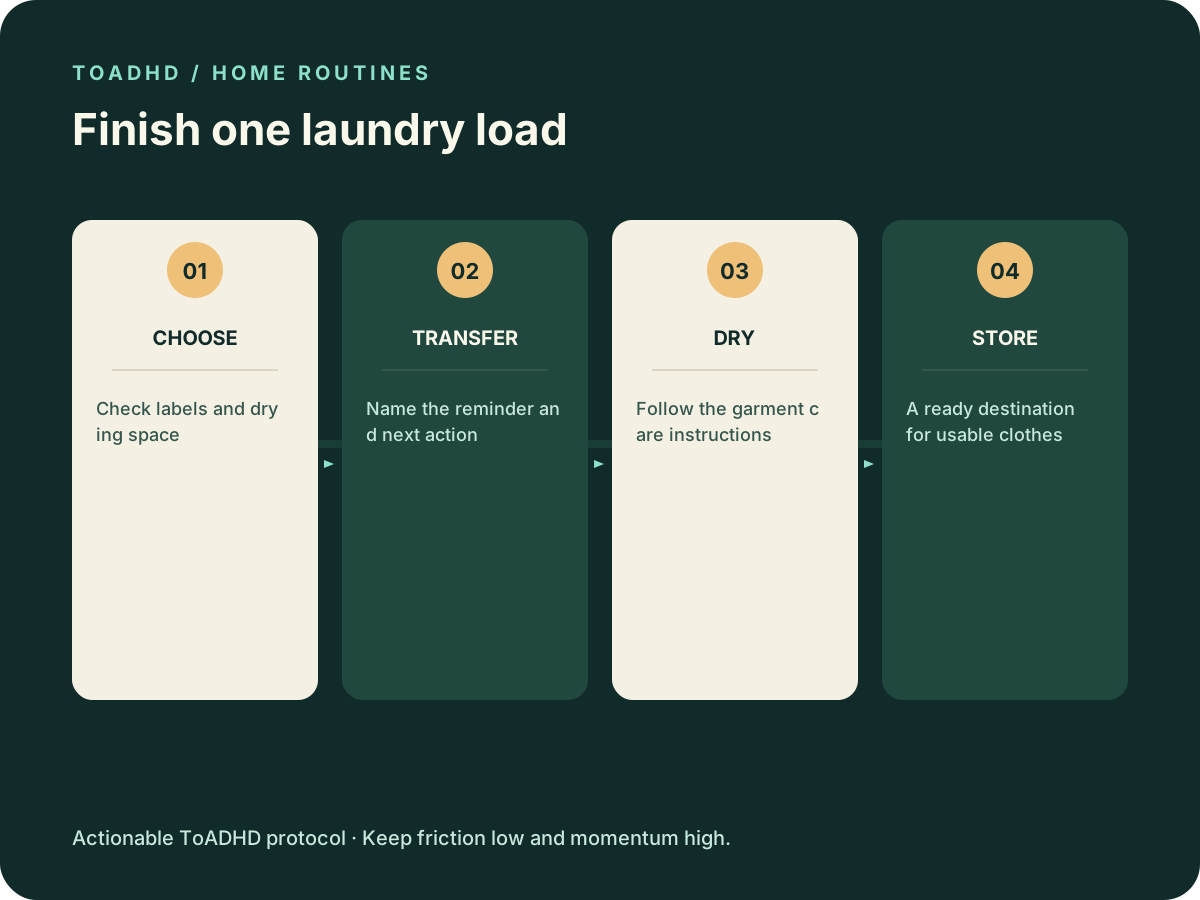
Plan the destination and the next handoff before starting the washer. Pick a manageable load, check the care labels, set a named reminder to move it, and reserve a place for the dry clothes. If folding is the bottleneck, use a simple storage option that suits the garments.
IN 30 SECONDS
What to remember
- One load includes drying and storage, not just a wash cycle.
- Use reminders that name the action, such as “move clothes to drying rack.”
- Choose a clean-clothes destination before the cycle begins.
- Simplify storage without ignoring garment care instructions.
Locate the stage where the load stops
Look at the laundry you have now. Is it dirty, wet in the machine, dry in a basket, or waiting to be put away? That state determines the next task. You do not need to restart the whole routine because one stage was delayed.
This is an editorial workflow for managing a household task, not a claim that all people with ADHD have the same laundry problem. The aim is to make each handoff visible, especially when a machine runs while your attention is elsewhere.
Write a load card before pressing Start
Use a note, a reusable card, or your phone. Include only the information needed to finish this load. Keep the care decision separate from the scheduling decision: a convenient cycle is not necessarily appropriate for every item.
FTC guidance explains that garment care instructions address washing, drying, and relevant warnings. Follow the actual garment label and appliance instructions rather than assuming one setting suits everything.
Load — Which compatible items am I washing?
Next handoff — When should I check the machine, and what will I move?
Drying space — Is the dryer or rack available?
Destination — Which drawer, hanger, or clean bin will hold the dry items?
Sources: [1]
Example: tomorrow's essentials, not the whole pile
Suppose you need a work shirt and a few everyday basics. Check whether they can be washed together. Choose a load that fits the appliance guidance and your available drying space. Keep items with different care needs for another load.
Before starting, clear the shirt's hanger and the basics' storage bin. Set a reminder labeled “Check washer; move this load to drying.” Use the machine's estimated cycle end as a check time, not a guarantee that it will be finished at that exact minute.
Make storage easier at the point of friction
If dry laundry repeatedly stops in a basket, test a smaller storage change. Everyday items that do not need careful folding might go in separate clean bins. Garments that wrinkle or need specific storage can go on hangers. Keep clean and dirty containers clearly distinct.
You do not need to reorganize the entire closet to try this. Choose one category for a week. Notice whether you can find it and whether it remains in usable condition. If the bin becomes another mixed pile, reduce the category or put the destination closer to where you unload.
Resume an interrupted load
Start from its present state: wet items need a care-appropriate next decision; dry items need a destination. If clothing smells musty or you are unsure how to handle it, consult reliable garment-care guidance rather than masking the smell or putting damp clothes away.
For the next attempt, change one handoff. Try a clearer reminder name, an available drying space, or a prepared storage destination. Track where the process stopped instead of treating the whole day as unsuccessful.
COMMON QUESTIONS
A few honest answers
Do I have to fold everything?
No universal routine requires that. Choose storage that keeps each garment usable and follows its care needs. A simple clean bin may suit some basics, while other items need hanging or folding.
What if I forget the reminder?
Check whether it was noticeable and whether it told you what to do. Move the cue to a place you use and choose a check time when you can act. Avoid relying on a notification you routinely miss.
SOURCES & REVIEW
Sources and further reading
- 1Clothes Captioning: Complying with the Care Labeling Rule ↗
Federal Trade Commission
This guide offers general productivity education. It cannot diagnose ADHD or replace care from a qualified professional.