THE SHORT ANSWER
Your starting point
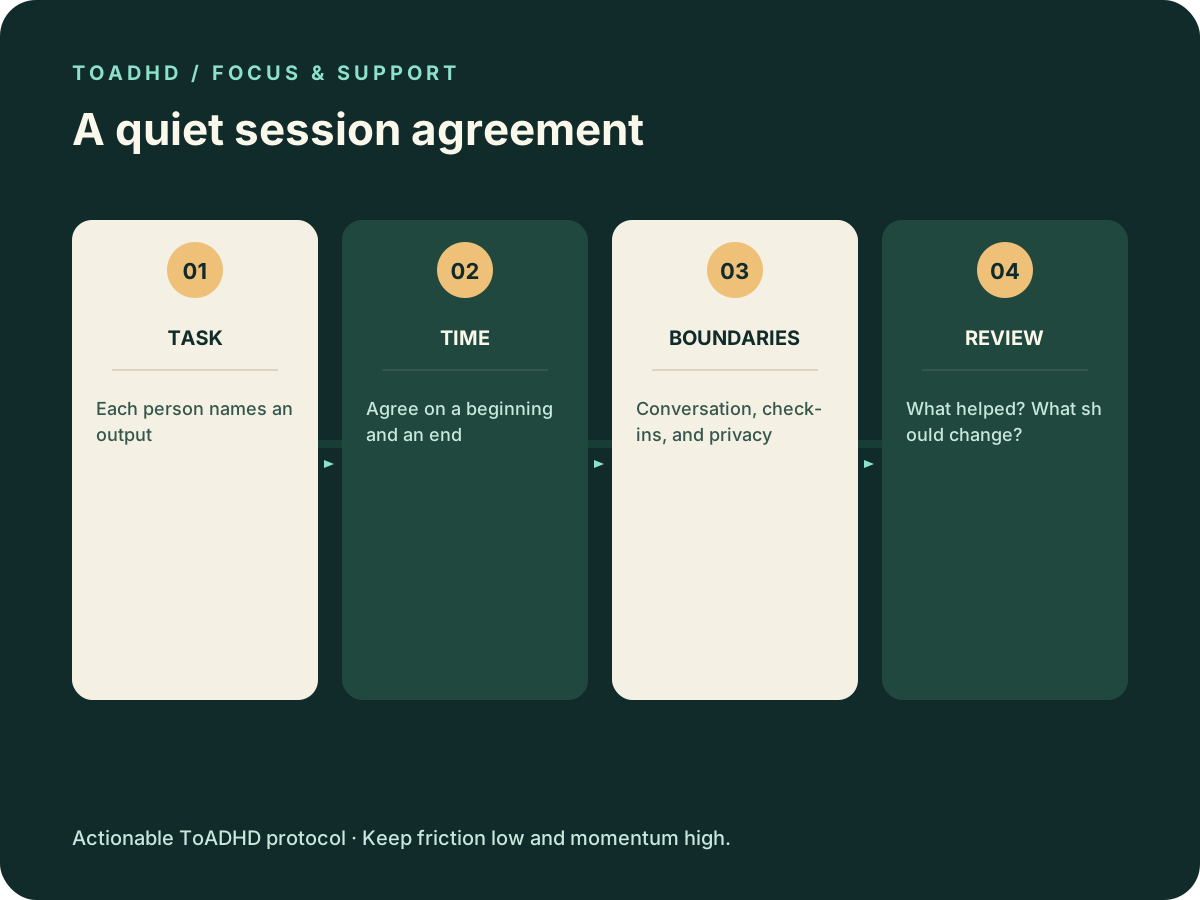
Agree with another person to work alongside each other, in person or remotely. Name your task, set the session's end time, and decide how much talking is welcome. Work independently, then briefly compare your intended output with what happened. Adjust or stop if the setup adds distraction or pressure.
IN 30 SECONDS
What to remember
- A body double can work on a different task.
- Agree on conversation, check-ins, and privacy before beginning.
- Choose a visible output for the session.
- Treat the setup as an experiment, not a guaranteed ADHD solution.
What body doubling means in practice
Cleveland Clinic describes body doubling as doing a task in the presence of another person, including through a video call. The other person does not have to perform the same work or supervise you.
This guide focuses on setting up a low-pressure session. It does not claim a proven effect size, promise symptom improvement, or present quiet company as a replacement for ADHD care. You can evaluate whether the arrangement is useful for the particular task in front of you.
Sources: [1]
Make a small agreement before starting
Ask someone who is willing to participate and able to respect the working arrangement. Be specific enough that “keep me company” does not turn into an unexpected demand for coaching or constant reminders.
Task — Each person names a concrete output.
Time — Agree when the session begins and ends.
Contact — Decide whether to work quietly or allow brief questions.
Privacy — Decide what is visible, what stays private, and whether cameras are needed.
Run the session without turning it into a meeting
At the start, say what you will work on in one sentence. Open the materials you need and begin. If conversation is distracting, agree to save it for the end. A body double is not automatically responsible for managing your attention.
At the agreed end, report the result plainly: “I labeled the files, but I still need to archive the duplicates.” You do not have to justify every minute. Choose whether to stop, continue by mutual agreement, or leave a next action for another session.
- 1
Name the output. Keep it specific enough to check.
- 2
Begin independent work. Follow the agreed conversation boundary.
- 3
Flag a change if needed. Ask before extending the session or changing its purpose.
- 4
Close with the result. Record the unfinished next action without judging it.
Example: two different tasks, one shared container
Imagine you are organizing a small digital folder while a friend works through course practice questions. You agree to 25 minutes of quiet work and no screen sharing. Your task is to rename the current project files; your friend's task is to attempt and check two questions.
At the end, you discover that deciding naming rules used most of your time. That is useful feedback: next time, bring a naming rule or make choosing it the stated output. The duration is illustrative, not a recommended clinical dose.
Change the arrangement if it adds friction
If you spend the whole session chatting, try a clearer quiet-work agreement. If being watched creates pressure, try side-by-side seating or another arrangement both people accept. If the task needs collaboration, call it a working meeting and agree on that purpose.
If finding a partner becomes a larger project than the work, start independently with one task. Body doubling is optional. Do not conclude that you cannot work alone because one supported session was useful.
Keep confidentiality and access in mind
Use your organization's approved tools for work. Do not expose confidential documents, client details, or account information through a shared screen. If you use a public or paid coworking service, check its rules and privacy terms yourself before joining.
After a session, ask: did I begin the intended task, did the company help or distract, and would I choose this setup again? Change one condition at a time so you can identify what was useful without treating one session as proof.
COMMON QUESTIONS
A few honest answers
Does the other person need ADHD too?
The practical arrangement does not require matching diagnoses. Willingness, compatible boundaries, and a workable environment matter for the session.
Is a recorded video the same as a live body double?
It is a different arrangement because the other person is not participating live. You can try a quiet work video if you want, but do not assume the same experience or research applies.
Does ToADHD connect me with a partner?
No. ToADHD provides task breakdown and one-step focus. Arrange a partner or coworking session separately.
SOURCES & REVIEW
Sources and further reading
- 1What Is ‘Body Doubling’ and Can It Help With ADHD? ↗
Cleveland Clinic
This guide offers general productivity education. It cannot diagnose ADHD or replace care from a qualified professional.